

By Vicki Bemont
I started in German Shepherd Dogs in the early 1970’s and became an AKC Judge in 1983. I have bred and/or owned specialty winners, group winners, and working dogs.
During my time in the breed, I have witnessed several decades of German Shepherd Dogs. Whenever breeders and judges get together, movement seems to be the dominant topic of conversation.
So much so that many times I wonder if that is the ONLY criteria for many fanciers. It most certainly is important—but there are many other aspects of breed.
Our standard does give significant language to proper movement. This is for good reason. Our dog is a working dog first and foremost. Sound, balanced movement is critical to the dog’s ability to work long hours as a herding dog, police or military dog, search and rescue dog, etc.
In our zeal to capitalize on movement, we have seen unfortunate trends in the breed.
Rotated fore assemblies, overly angulated hindquarters, and poor proportions have led to many dogs who do not have the physical soundness to work all day. And at the end of the day physical and MENTAL soundness are the overriding requisites for this Breed.
Our standard talks about dogs who have the look of muscular fitness and agility. He should be able to stand strongly over his feet. In motion he should be smooth and rhythmic. The motion of the hindquarter is described as smooth with good follow through. Over reaching where the hind leg comes under and the dog actually lands on his hock is to be faulted. So is a dog whose toes drag the ground as they come under. The hock joint should fully open as does the stifle with a smooth powerful thrust from the rear. The rear legs should come forward and drive the dog forward with a smooth, powerful thrust — the rear foot passing the imprint of the front foot. The dog should resemble a well oiled machine.
The smooth flowing gait is maintained with great strength and firmness of back.
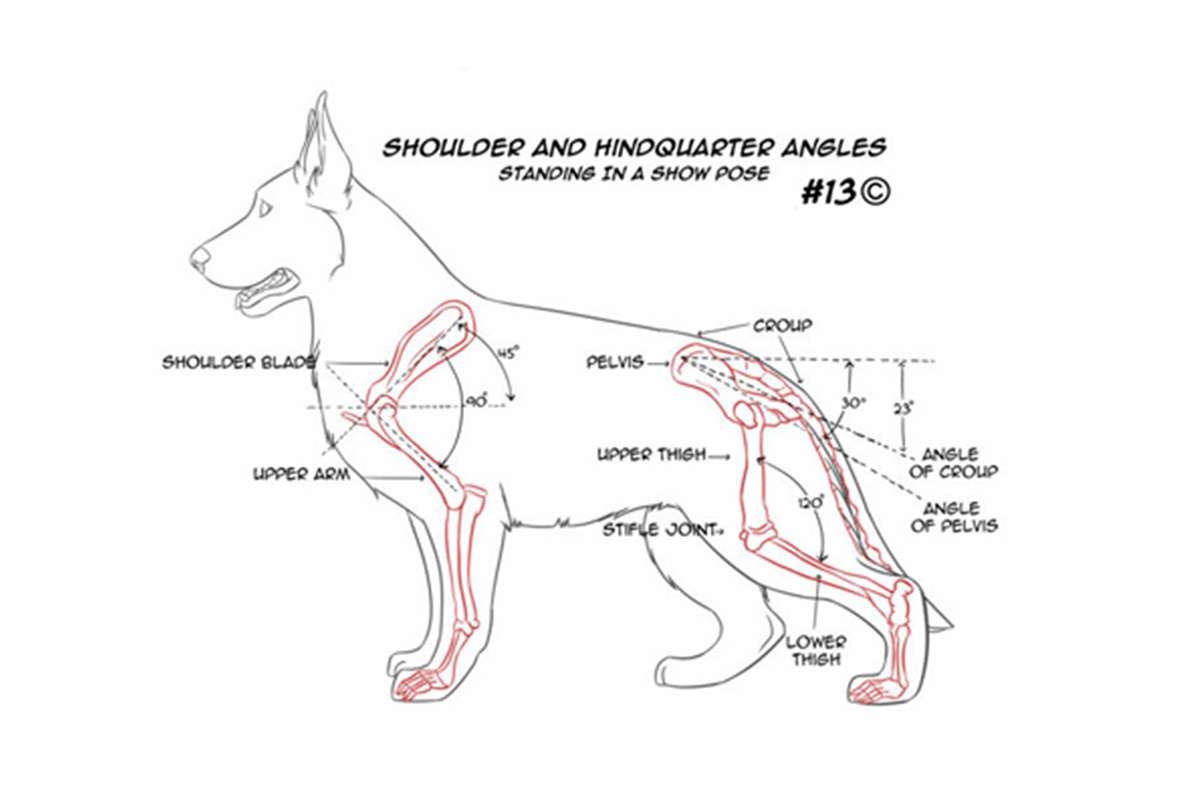
When standing in a natural, four square pose the upper thigh bone should parallel the shoulder blade while the lower thigh bone parallels the upper arm. The metatarsus should be strong. Shoulders should be long and obliquely angled. The standard specifically mentions they should not be placed forward. The powerful effort of the hindquarter is transmitted through the back.
The shoulder should open to its full extent. The feet should stay close to the ground, not lifting high. Through the years I have seen some flashy movers who “point” and “lift” in the front, giving the false illusion of extreme motion—but the footfall is a different matter altogether. This sort of motion is flashy but exhausting to the dogs.
As a working dog, the German Shepherd Dog’s movement is best evaluated at a slow speed similar to the speed the dog would use in tending flocks or doing other types of work central to the breed. Excessive speed should not be used to evaluate our dogs.
It is to be remembered in all things that the German Shepherd Dog is a WORKING dog and must possess the physical and mental soundness necessary for arduous tasks.
Vicki Bemont has been an AKC Judge of German Shepherd Dogs for 40 years. She is a breeder, exhibitor and CGC evaluator. Vicki has titled dogs in Obedience, Agility, Herding, Rally and Schutzhund. Additionally she worked as a SAR handler for many years and trained dogs for HRD, Air Scent, and Water Recovery.
